How IMD Classifies Cyclones: From Depression to Super Cyclonic Storm
Why a Scale Matters
When the India Meteorological Department (IMD) says a system is a "Very Severe Cyclonic Storm", it is giving a precise warning about the wind you can expect. The name is not a general description. It is a category defined by the strength of the wind near the centre, and each step up means far more damage.
The IMD Scale
IMD classifies a tropical system by its maximum sustained wind, averaged over three minutes:
- Depression (D): 31-49 km/h
- Deep Depression (DD): 50-61 km/h
- Cyclonic Storm (CS): 62-88 km/h
- Severe Cyclonic Storm (SCS): 89-117 km/h
- Very Severe Cyclonic Storm (VSCS): 118-166 km/h
- Extremely Severe Cyclonic Storm (ESCS): 167-221 km/h
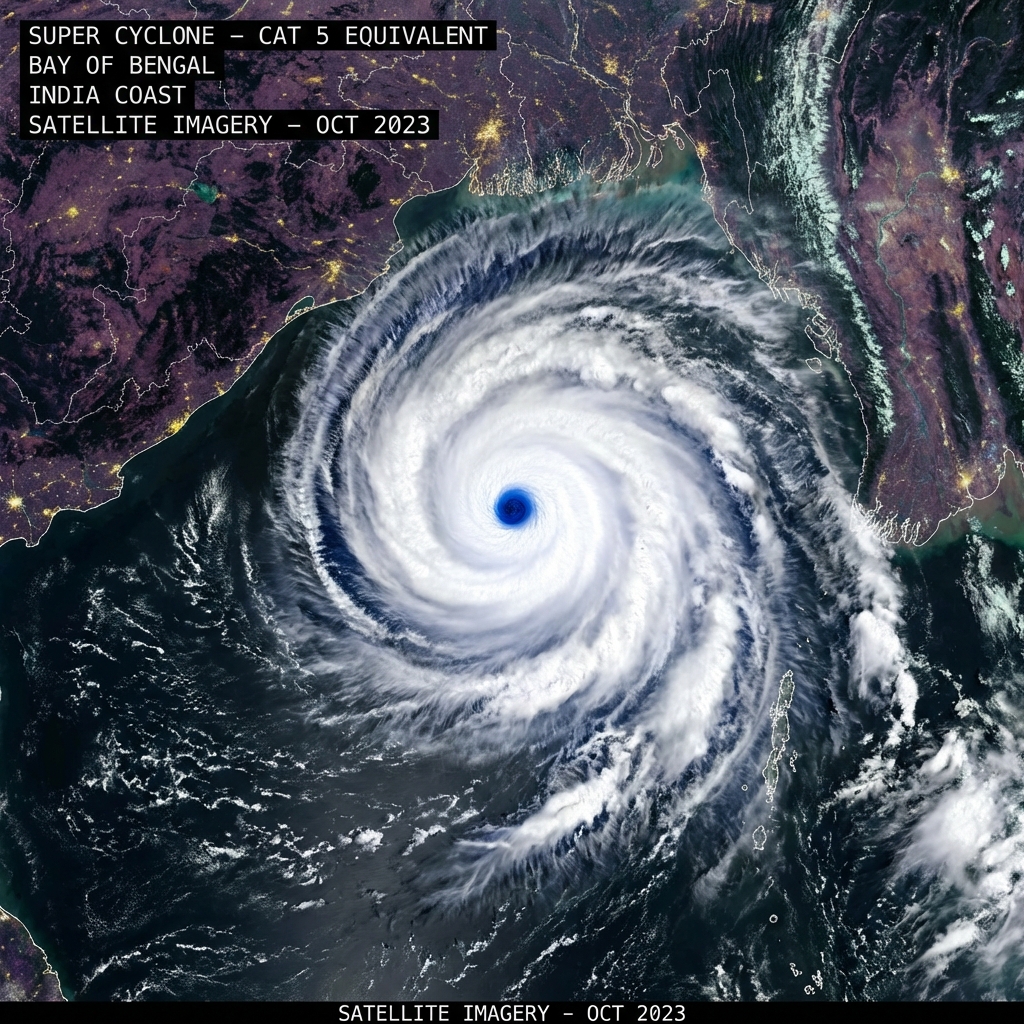
- Super Cyclonic Storm (SuCS): 222 km/h and above
Systems weaker than a Depression are called Low Pressure Areas or Well Marked Low Pressure Areas. They are watched closely, but they are not yet cyclones and do not get a name.
Three-Minute Winds vs One-Minute Winds
The same storm can be reported with different wind speeds depending on the agency. IMD averages the wind over three minutes. The United States Joint Typhoon Warning Center uses a one-minute average, which gives a higher number for the same storm. That is why a cyclone can be listed as 240 km/h on one website and 260 km/h on another. Neither is wrong. They measure the wind differently. On this site we use IMD's figures.
What Counts as a Super Cyclone
A Super Cyclonic Storm needs sustained winds of at least 222 km/h. In our archive, four storms crossed that line: the 1999 Odisha Super Cyclone (260 km/h), Amphan in 2020 (240 km/h), Gonu in 2007 (240 km/h) and Kyarr in 2019 (240 km/h). You can see them all on the Super Cyclones page.
Some famous storms came close but did not cross it. Fani (2019), Phailin (2013) and Mocha (2023) all peaked at 215 km/h, which is 7 km/h short of the line.
Peak Strength Is Not Landfall Strength
A cyclone can reach its peak over open water and weaken before it reaches land. Amphan is the clearest example: it was a Super Cyclonic Storm at 240 km/h in the Bay of Bengal, but by the time it crossed the coast near the Sundarbans its sustained winds were about 155-165 km/h. The 1999 Odisha cyclone, by contrast, was still at full strength when it crossed near Paradip. Always check both numbers.
Sustained Wind vs Gusts
Sustained wind is the steady average. A gust is a short burst that can be much stronger. Gusts are what tear off roofs and bring down trees, so we show both on every cyclone page.
Where to Check the Official Category
For the current classification of any system, use the official bulletins from IMD at mausam.imd.gov.in. This site is an independent explainer and not a warning service.