Was Cyclone Arnab Really a Cyclone? Deep Depression vs Cyclonic Storm Explained
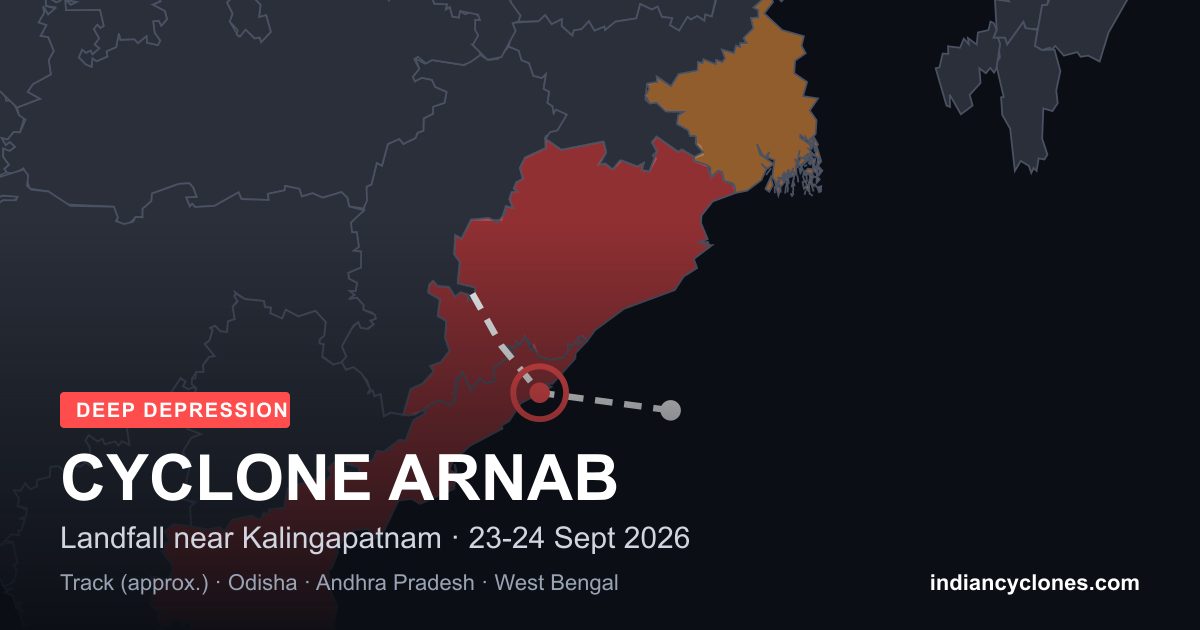
Short answer: No. IMD classified the September 2026 Bay of Bengal system as a Deep Depression through landfall near Kalingapatnam, Andhra Pradesh. It never reached cyclonic storm strength, so it was not officially named. “Cyclone Arnab” was a label used by many news outlets because Arnab was the next name in line. For the full story of the system, read our Cyclone Arnab journey, rainfall and affected areas report.
What Does Arnab Mean and Who Chose It?
Arnab is a Bengali word meaning “ocean” or “sea”, contributed by Bangladesh to the North Indian Ocean naming list maintained by IMD for the WMO/ESCAP Panel on Tropical Cyclones. Names are used in order, and only when a system reaches cyclonic storm strength. Because Arnab was next on the list, searches for “Cyclone Arnab” rose as soon as the Bay of Bengal system strengthened, even before any naming decision.
Deep Depression vs Cyclonic Storm
IMD grades systems by maximum sustained wind speed:
- Depression: 31–49 km/h
- Deep Depression: 50–61 km/h
- Cyclonic Storm: 62–88 km/h, the point at which a name is assigned
This system peaked as a Deep Depression, with squally gusts to about 75 km/h near the coast. Gusts are not sustained winds, which is why it stayed below the naming threshold. Our explainer on how IMD classifies cyclones covers the full scale.
Why a Deep Depression Can Still Be Dangerous
Intensity labels describe wind, not rain. A slow-moving Deep Depression crossing the coast can dump extreme rainfall: Semiliguda in Koraput, Odisha, recorded roughly 230 mm in 24 hours, and flooding was reported in parts of Andhra Pradesh. Landslides are a particular risk in hilly districts such as Gajapati, Darjeeling and Kalimpong. Read how IMD colour-coded warnings work to understand red, orange and yellow alerts.
Similar Storms in Our Archive
Landfalls on this stretch of coast have a long history. Compare with Cyclone Titli (2018) and Cyclone Phailin (2013), both of which were far stronger. Browse the whole cyclone archive.
Will the Name Arnab Be Used Later?
Yes. Because this system was not named, Arnab remains the next name for the next North Indian Ocean cyclone that reaches cyclonic storm strength.
Sources
IMD classification and naming rules: IMD. Event details as reported by The Week and Vajiram & Ravi.